
The Comité Técnico de Árbitros (CTA) of the Royal Spanish Football Federation, in an interview with Camel Live, conducted a centralized review and technical assessment of 51 decisions reviewed this season, and officially confirmed that 10 of them were wrong. Based on full-match videos, multi-angle footage and rule provisions, the program covered controversial decisions in La Liga, La Liga 2 and women's football. The case selection was done by an advisory committee consisting of three renowned coaches—Oltra, Sandoval and Sánchez-Villa—and club legend Morientes, and the content of the program represents the official stance of the CTA.
These 10 decisions ruled as referee errors or VAR intervention mistakes showed an obvious distribution in terms of results. Among them, Atlético Madrid benefited the most: including the incident in the match against Alavés where Giuliano Simeone was in an offside position but the referee mistakenly reviewed a handball, and the semi-automated offside system also misread the situation; as well as Koke's action of pulling goalkeeper Battaglia by the neck in the match against Rayo Vallecano, which should have resulted in a red card dismissal but was not properly handled.
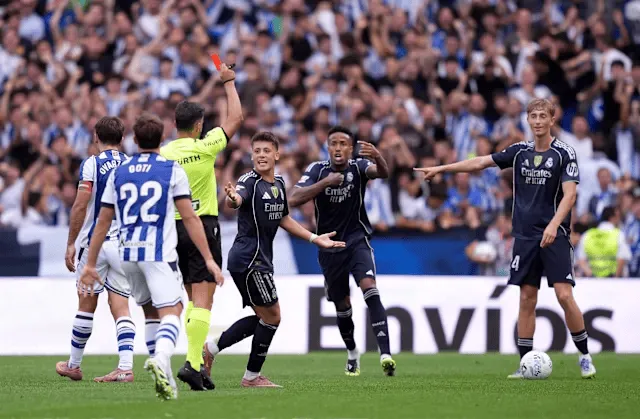
Barcelona also received one clear "beneficial wrong decision": in the match against Mallorca, the ball hit Rajó hard, and a foul should have been called for safety reasons, but this phase eventually led to a goal during the subsequent attack. In addition, Real Sociedad (benefiting from the wrong red card decision on Hoyos in the match against Real Madrid), Athletic Bilbao (benefiting from the penalty won by Nico in the match against Celta Vigo), Alavés (benefiting from a clear missed penalty in the match against Rayo Vallecano), Mallorca (benefiting from the goalkeeper not being sent off in the match against Athletic Bilbao) and Rayo Vallecano (benefiting from a clear missed penalty in the match against Espanyol) each received one officially confirmed favorable wrong decision.
Among the "disadvantaged parties", Real Madrid was deemed the hardest-hit team among the big clubs. When reviewing Hoyos' foul for Real Sociedad, the CTA stated that although the action was a "gray-area decision" and VAR's non-intervention was understandable, the referee should have given a yellow card instead of upholding the original red card decision.
Rayo Vallecano, with two obvious unfavorable wrong decisions, was ranked among the most disadvantaged teams overall: one was Atlético Madrid's foul of pulling Battaglia by the neck, and the other was Alemão being pulled for a long time in the match against Alavés without a decision being made. In addition, Espanyol (Mendy's handball not called and VAR not intervening in the match against Rayo Vallecano), Celta Vigo (Nico's penalty-winning action in the match against Athletic Bilbao being wrongly intervened by VAR), Athletic Bilbao (Leo Roman knocking down Marwan from behind in the match against Mallorca without receiving a red card), Mallorca (Rajo being hit without a foul being called in the match against Barcelona) and Alavés (in the match against Atlético Madrid) were also classified as disadvantaged by wrong decisions.
In addition, there were VAR intervention issues in two matches (Elche vs Athletic Bilbao, Valencia vs Villarreal), but the referees did not change the original decisions and the final results were deemed correct, so they were not included in the list of beneficial or disadvantaged cases. In the review of the remaining 38 decisions at the first-team level, the CTA believed that VAR either correctly intervened to remind the referees or chose not to intervene to let the referees' decisions take effect, and all results were deemed reasonable.
The only case where VAR corrected a decision unfavorable to Real Madrid was Eric García's handball in the first-round El Clásico at the Bernabéu, which was reviewed and a penalty was awarded. As for other decisions involving Real Madrid, the CTA pointed out that either the game was allowed to continue regardless of whether it was favorable to Real Madrid (including Vinícius' falls in the matches against Barcelona and Alavés), or there were two decisions that canceled the original rulings favorable to Real Madrid.
From the perspective of "gains and losses from error correction", the data of Barcelona and Atlético Madrid are relatively close: Barcelona had one "correction of a decision favorable to itself" (Bartra's handball penalty in the match against Betis) and one "correction of a decision unfavorable to itself" (the ruling that the goal against Osasuna was invalid); Atlético Madrid had two "corrections of decisions unfavorable to itself" (Sørloth's dismissal, Griezmann's obstruction leading to Baena's goal being invalid). Among the four Atlético-related decisions where VAR "chose not to intervene and was deemed correct", three occurred in the Madrid Derby (Sørloth's hug with fans, Güler's penalty, Le Normand's position in the free-kick goal).
The CTA stated that as a new form of public decision review mechanism in Spanish football, its goal is to improve the transparency of refereeing decisions, help players, coaches and fans understand the scale of decisions, and take a higher degree of information disclosure as the main line of work. Currently, the project is led by Fran Soto, the head of the Technical Refereeing Committee.