
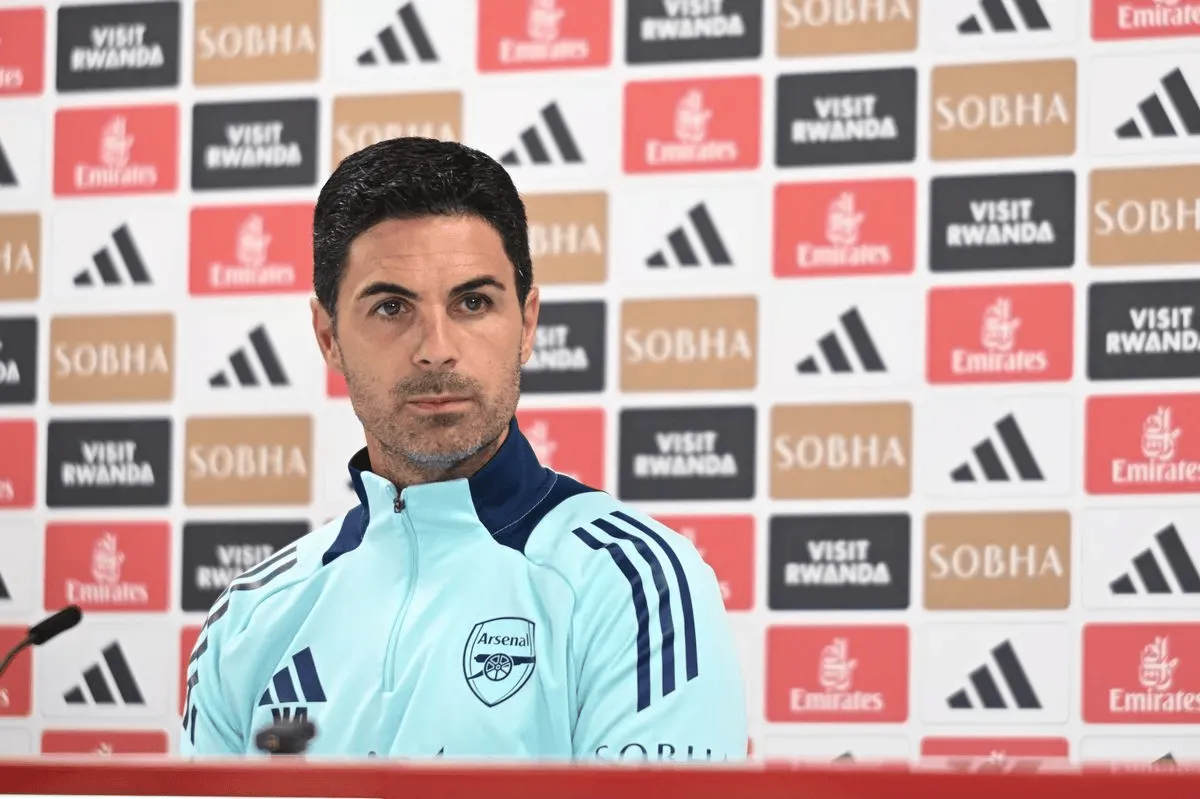
Ahead of Arsenal’s Premier League clash with Bournemouth in this round, Gunners manager Mikel Arteta attended the pre-match press conference, where the Spaniard addressed a host of relevant topics and updates.
Would you be satisfied with a four-point lead going into the second half of the season if told at the start? Do you now think the direct head-to-head could be a title decider?
We are happy with where we are, but there is always room for improvement. Our focus now is on the first game of the new year against Bournemouth, a team that is extremely hard to beat for anyone.
Losing only two games this season, this stability is exactly what’s needed to win the title, right?
Yes, but it’s only early January, and there are still five months to go. We need to do much more.
The team’s discipline has improved with no red cards this season. How much credit do you take for this? Did you emphasize keeping 11 men on the pitch at the start? Have you toned down your passionate touchline antics too?
This topic is better summed up at the end of the season. Red cards are sometimes down to players’ decisions, and sometimes even out of their control. I’ve had periods with lots of red cards and phases with none during my tenure, there are fluctuations. We know defensive stability is vital and will keep 11 men on the pitch as much as possible.
Finally on Rice: You once said he could challenge for the Ballon d’Or. Being able to play multiple positions is sometimes seen as a weakness, but he excels in every role—this is a strength for him, isn’t it?
This is hugely positive for him individually, the team, the club and football itself. Having a player with this adaptability, mental attributes and ability to fill different roles makes the team much stronger.
On xG: Actual goals have lagged behind expected goals for weeks. How do you view the reference value of this data algorithm for the team?
It’s just one of many stats and highly volatile. All teams have long periods of overperforming xG, but is that sustainable? Clearly not. Games shift dynamically, and the last 10 minutes can overturn 80 minutes of data. We can use this stat selectively, but there are far more important metrics for the team.
Back to Rice: He was kicked during the Brighton game, played the full 90 but clearly had knee discomfort. Now knowing the injury, do you regret not substituting him? How do you assess the injury?
No, it was normal for him to carry on at the time. Sometimes after a knock, adrenaline and body heat get you through the game, but the post-match reaction can be worse than expected—and unfortunately that’s what happened here.
Arsenal have had frequent injuries in the past 18 months. What goes through your mind when learning of a new injury? Has your mindset changed?
First, think about how to improve, then accept this is the reality of football. Looking back at the past three seasons, our injury days are actually fewer than before. We need to distinguish between serious injuries and minor knocks, we’re still seeking improvements but doing better than some years.
With players returning from injury, does it bring not only rotation options but also greater tactical flexibility to try combinations you couldn’t before?
Ultimately it’s about on-pitch performance, not rotation. We chase the highest level of performance every three days or in every game. To achieve that, we need to field the players in the best form and with the best understanding.
Has Trossard stepped up another level this season? Is this the best form you’ve seen him in?
He improves every season. He’s an extremely intelligent player with a fierce winning mentality, he’s found his role and maturity here, and his confidence is higher. He can produce magical moments and is vital to the team.
He had a special pay rise without a contract extension this summer, with 18 months left on his deal. Would you like him to sign a new contract?
We are very happy with him. We’ve communicated multiple times, and I believe he’s happy here too.
On the "finisher" concept you spoke of last season: Seeing Jesus’ performance against Villa, plus players like Nwaneri with their own roles, how important is the "finisher" in the closing stages when making game plans?
Extremely important. The key is you never know if you’ll start, be the finisher, or come on as a late sub due to a warm-up injury—that’s why you need to stay ready. It’s reassuring that the players are fully committed and willing to take on any role.
A notable stat: Arsenal have failed to win the title after topping the table on New Year’s Day in the last five times. Are you aware of this statistic?
I wasn’t. Then let’s break it.
That’s certainly the target. How do the players feel? How desperate are they to reverse this stat and win the title in the end?
You can clearly feel the determination from the desire and energy they bring to training every day and every game. There are still five months to go, we need to stay grounded, enjoy where we are and push forward with all we have.